The Crisis of Coordination in Public Health
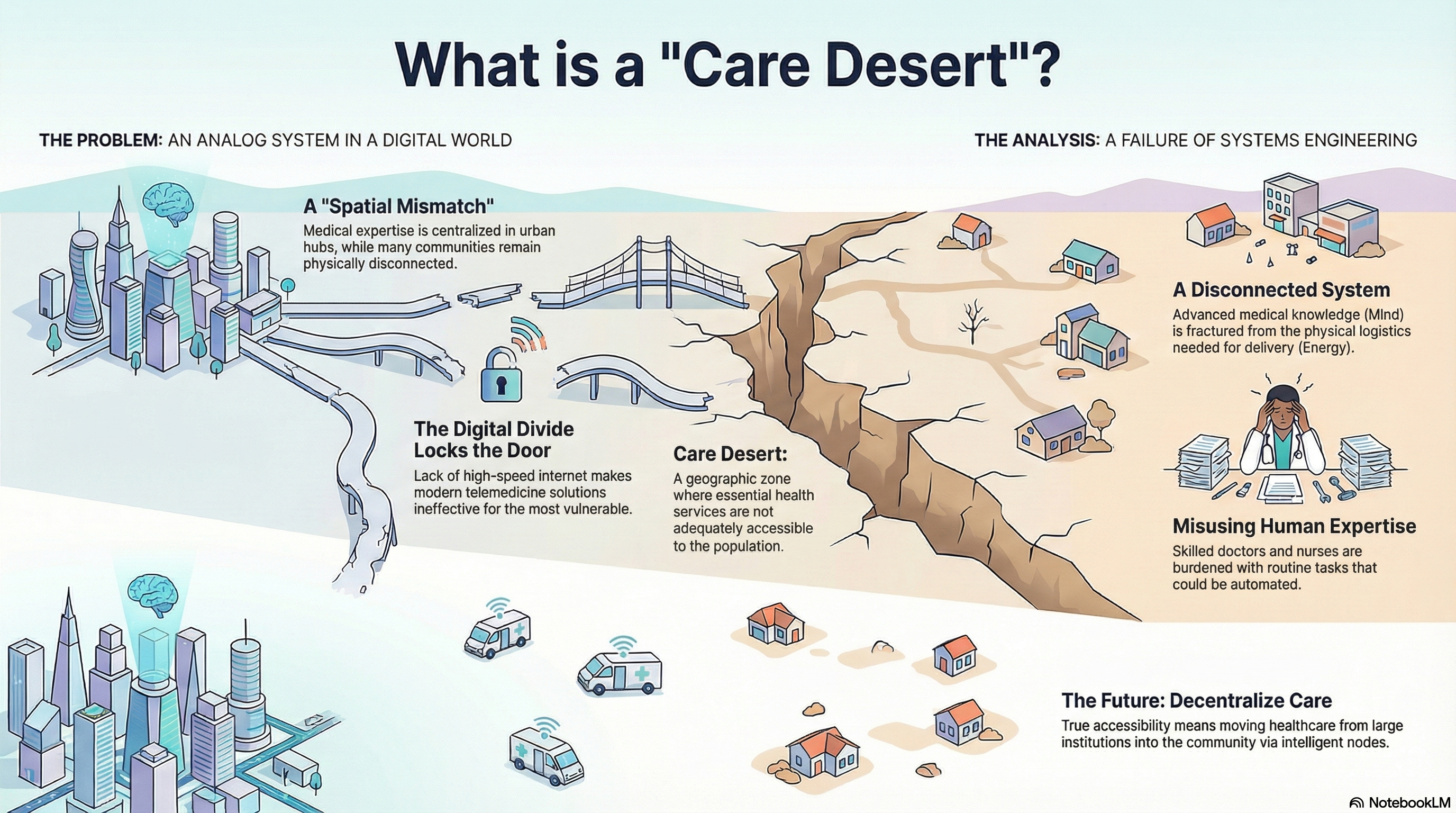
The anatomy of "Care Deserts" and the Last Mile Problem
The fundamental phenomenon addressing the inaccessibility of basic medical services is best understood through the concept of "Care Deserts." These are geographic or socioeconomic zones where the population lacks adequate access to essential health services, creating a profound "Last Mile" problem in public health delivery. While modern medicine has achieved expert-level diagnostic capabilities, these advancements remain centralized in urban hubs, effectively decoupling "capacity" from "delivery." Current data indicates that rural populations experience significantly higher mortality rates from treatable conditions compared to urban populations, primarily due to the logistical friction of accessing care. This is not simply a lack of doctors; it is a spatial mismatch between where expertise resides and where humanity lives.
The phenomenon is exacerbated by the "Digital Divide," which renders traditional home-based telemedicine ineffective for the most vulnerable. A significant percentage of rural residents lack the high-speed broadband required for video consultations, meaning the "digital front door" to healthcare is locked for millions. Consequently, the current system relies on a high-friction, brick-and-mortar model that forces patients to travel long distances for minor ailments. This inefficiency leads to delayed treatment, where manageable minor illnesses escalate into critical emergencies, overburdening the tertiary care system. The concept here is clear: the current infrastructure is an "analog" solution trying to serve a digital-speed world, resulting in a systemic failure to coordinate care for the 8 billion people on the planet.
The Triune Intelligence System Engineering (TISE) Disconnect
From a systems engineering perspective, the phenomenon of inaccessibility can be analyzed using the Triune Intelligence System Engineering (TISE) framework. TISE posits that a functional system must harmonize three layers: The Mind (Homodeus/Artificial Intelligence), The Heart (Homocordium/Human Values), and The Energy (Natural Intelligence/Physics). The current crisis represents a fracture in this triad. We have developed "The Mind" (advanced medical knowledge and diagnostic AI), but we lack the distributed "Energy" (physical infrastructure and logistics) to deliver it, and we often fail "The Heart" by ignoring the cultural and emotional needs of underserved communities.
The prevailing model of healthcare delivery fails to utilize the "Synergistic Practical Intelligence" (PI-A) available through modern technology. Instead of leveraging automation to handle routine "lower-order" tasks (like triage and dispensing basic meds), we continue to rely on "Human Energon" (doctors and nurses) for every interaction. This misallocation of human intelligence creates bottlenecks. The concept of "accessibility" therefore needs to be redefined: it is not just about building more hospitals (which is economically unfeasible), but about creating a "Mahakarya Rekayasa" (Masterpiece of Engineering) that decentralizes care, moving the locus of health from the institution to the community through autonomous, intelligent nodes.