The IST Student's Stance on Bridging The Gap
This section articulates my professional stance as an Information Systems Technology (IST) student, arguing that the solution requires a shift from passive technology support to proactive socio-technical system design.
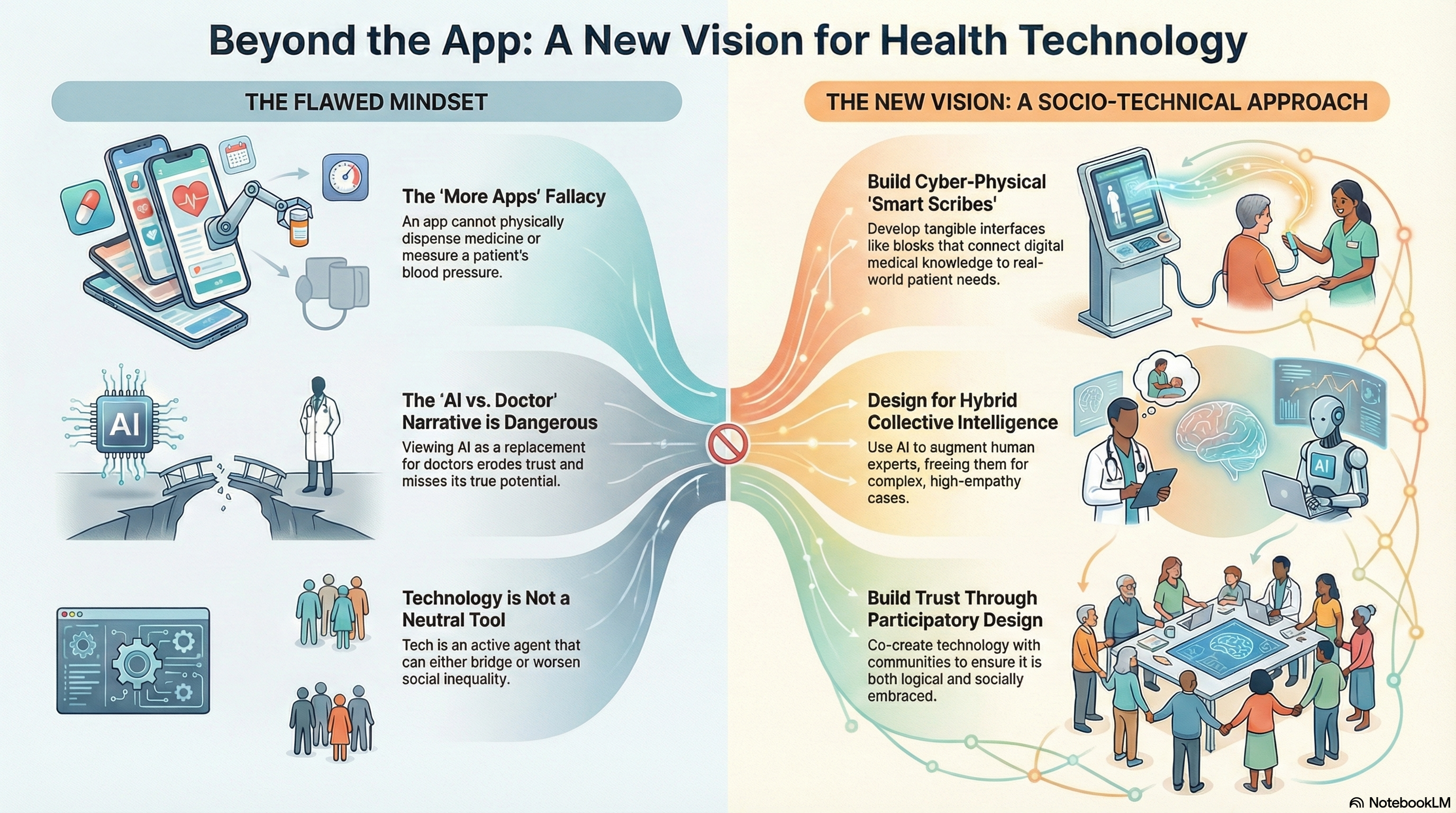
The Moral Imperative of the "Smart Scribe" (Juru Tulis Cerdas)
As an undergraduate in Information Systems, I believe my role must evolve beyond merely writing code to becoming an architect of "Social-Technical Ecosystems." I firmly oppose the view that technology is a neutral tool, rather, it is an active agent that can either exacerbate or bridge inequality. My stance is that we must utilize IT to act as the "Juru Tulis Cerdas" (Smart Scribe/Instrument) described in the TISE philosophy. We possess the "Homodeus" capabilities: the algorithms, the data processing power, and the connectivity, but we have a moral obligation to direct these powers toward "Homocordium" (human-centric) goals. Facing the condition of health inaccessibility, inaction is a failure of our discipline.
I argue that the standard approach of "more apps" is insufficient. An app cannot dispense antibiotics to a patient with an infection, nor can it physically measure blood pressure for a user without a device. Therefore, my opinion is that IST students must embrace "Cyber-Physical Systems" solutions that bleed out of the screen and into the physical world. We must design systems that are not just "smart" but "tangible." The action I advocate for is the development of autonomous physical interfaces, maybe kiosks or vending machines, that serve as the bridge between the digital cloud of medical knowledge and the physical reality of a patient’s needs. This is the only way to operationalize our technical knowledge to solve the "problems of humanity."
Advocating for Hybrid Collective Intelligence
I strongly believe that the narrative of "AI replacing doctors" is both false and dangerous. Instead, my opinion is that we must design for Hybrid Collective Intelligence. We should view the AI not as an oracle, but as a high-precision filter that augments the human care network. In the face of the provider shortage crisis, it is illogical to demand that a human physician handle every case of the common cold. My stance is that we must delegate these routine PUDAL (Perception, Understanding, Decision, Action, Learning) cycles to machines to preserve the "Human Energon" for complex, high-empathy cases.
Furthermore, I argue that trust is the currency of this transaction. A purely algorithmic system will be rejected by the "Heart" of the community if it feels cold or alien. Therefore, my action plan involves advocating for "Participatory Design," where the technology is co-created with the communities it serves. We must treat the user not as a passive recipient of data, but as a "Protagonist-Author" in their own health narrative. By integrating local cultural norms and human-in-the-loop escalation protocols, we can build a system that is technically robust ("Logic") and socially embraced ("Heart").